
Regular sweeping, cleaning when needed and prompt stain treatment help protect a resin bound surface throughout its service life. Follow the named system's maintenance instructions and any conditions in your written warranty rather than relying on a universal schedule.
Routine cleaning
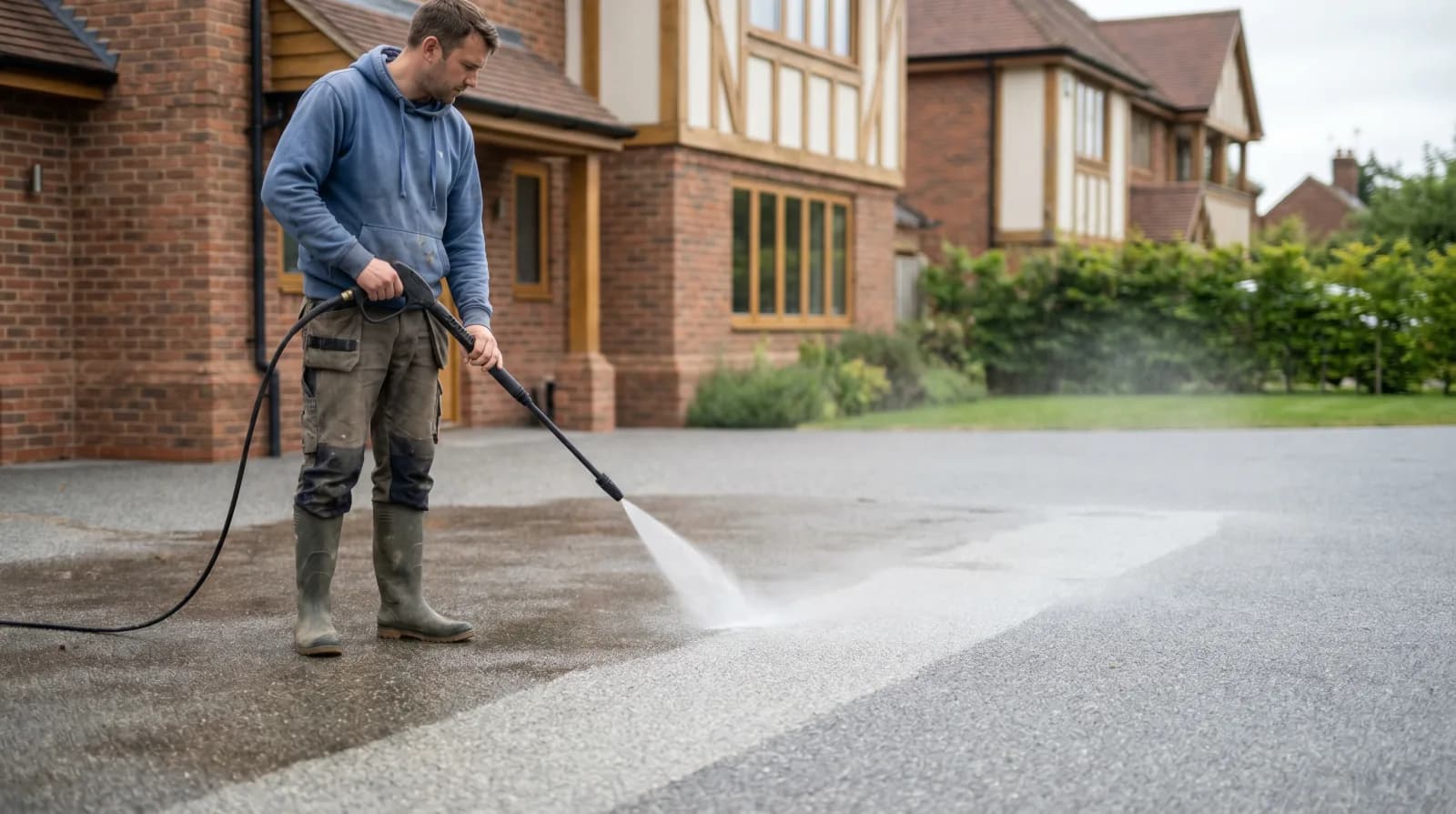
Sweep regularly with a broom or leaf blower so decomposing leaves and abrasive grit do not sit on the surface. Wash when dirt or organic growth builds up. If using a pressure washer, follow the installer or resin manufacturer's limits: a fan nozzle, moderate pressure and a sensible stand-off distance reduce the risk of disturbing aggregate. Avoid concentrating a rotary jet in one place, using an incompatible chemical, or washing when the water may freeze.
Weeds, moss and algae
A correctly laid surface resists weeds because it has no open paving joints, but seeds can still germinate in surface debris as well as at edges and cracks. Remove growth without damaging the surface. Moss and algae favour shaded, damp spots; sweep off loose growth and use a cleaner confirmed as compatible with the named resin system, following the product label before rinsing.
Do you need to reseal?
A sound resin bound surface does not normally need a fixed resealing schedule. Avoid generic sealers: an incompatible coating can change colour, reduce grip or clog the open structure that lets water pass through the surface. If aggregate starts to loosen or the wearing course is visibly degraded, ask the original installer or system manufacturer whether a compatible local repair or renewal coat is appropriate.
Common problems: cause and fix
- Cracking → may reflect movement or cracking in the base, inadequate joints, loading or edge failure. The cause determines whether filling, a local cut-out or base reconstruction is needed.
- Loose stones (ravelling) → can result from mix, moisture, contamination, wear or loading. Use a repair product approved for the named system; extensive failure may need a cut-out and relay.
- UV yellowing → often indicates a non-UV-stable resin. A specialist should assess whether cleaning, a compatible renewal treatment or replacement is realistic.
- Oil stains → absorb the excess promptly, then use a compatible degreaser and rinse as directed. Test any cleaner on an inconspicuous area first.
- Ponding / puddling → wrong fall, a non-porous base, or pores clogged with fines. Jet-wash clogged pores; correcting drainage is a bigger job.
- Foaming / white patches → can indicate moisture during mixing or curing. Report it promptly and ask the installer or system provider to assess it under the written warranty.
Repairs and cost
A professional can cut out a damaged area and relay a compatible aggregate-and-resin blend, but colour and texture matching are rarely exact on a weathered surface. Price depends on access, minimum call-out, the cause and whether the base also needs repair. Check the warranty before appointing a third party, because unauthorised work may affect cover.
Winter care
A complete permeable build reduces standing water, but ice can still form. Clear snow with a plastic or rubber-edged shovel and avoid tools that can gouge the aggregate. Check the manufacturer's advice before using de-icer or salt, then rinse residues when conditions allow. Do not pressure-wash when water may freeze.
How long it lasts — and what shortens it
Both the resin system and its base affect service life. Failure can be caused by a poor or missing sub-base, cheap aromatic resin, inadequate drainage, failing edge restraints, heavy vehicles on an under-spec base, and “dry steering” (turning the wheel while stationary). Most of this is decided at installation — see how a resin driveway is installed and choosing an installer.
Maintenance schedule
| Task | How often |
|---|---|
| Sweep leaves and debris | Regularly and after storms |
| Wash using the system's approved method | As needed |
| Treat moss or algae with a compatible product | As needed |
| Inspect edges and kerbs | Periodically |
| Treat oil / fuel spills | Promptly |
| Professional condition assessment | If stones loosen, cracks appear or drainage changes |